A trusted person can make a dense payment document easier to understand. They might enlarge text, read a paragraph aloud, explain an unfamiliar word, or help you keep your place. Those useful tasks do not automatically require them to see your balance, operate your account, or receive future correspondence. Agreeing on the role first makes help more comfortable for both people.
Start with a public Corpay Prepaid source whenever it can answer the question. You can practice the reading method before deciding whether any private material needs to be involved. This article concerns informal reading assistance for an adult. It does not establish legal authority, an authorized representative relationship, or a provider’s rules for discussing an account with another person.
Make the request specific enough to finish
Instead of “Can you handle this for me?” try “Please read this public paragraph with me and help me list what I need to ask.” Specify the result, the helper’s actions, and where you will stop. A person who is comfortable explaining terminology may not be comfortable managing files, and a person who knows the computer may not understand a financial notice.
In a fictional example, Denise asks her neighbor Ari to help with small print. Denise wants to know what an electronic communication document expects of the reader’s equipment. Ari agrees to enlarge the public PDF and read section headings. Denise will decide which questions to keep and whether to seek an individual explanation. They agree that Ari will not save personal records or receive messages for her.
This division is deliberately ordinary. It lets Ari be useful without becoming the owner of the task. Denise can revise the plan at any point, including deciding that a different helper or official assistance would be more appropriate.
Separate reading, handling, and deciding
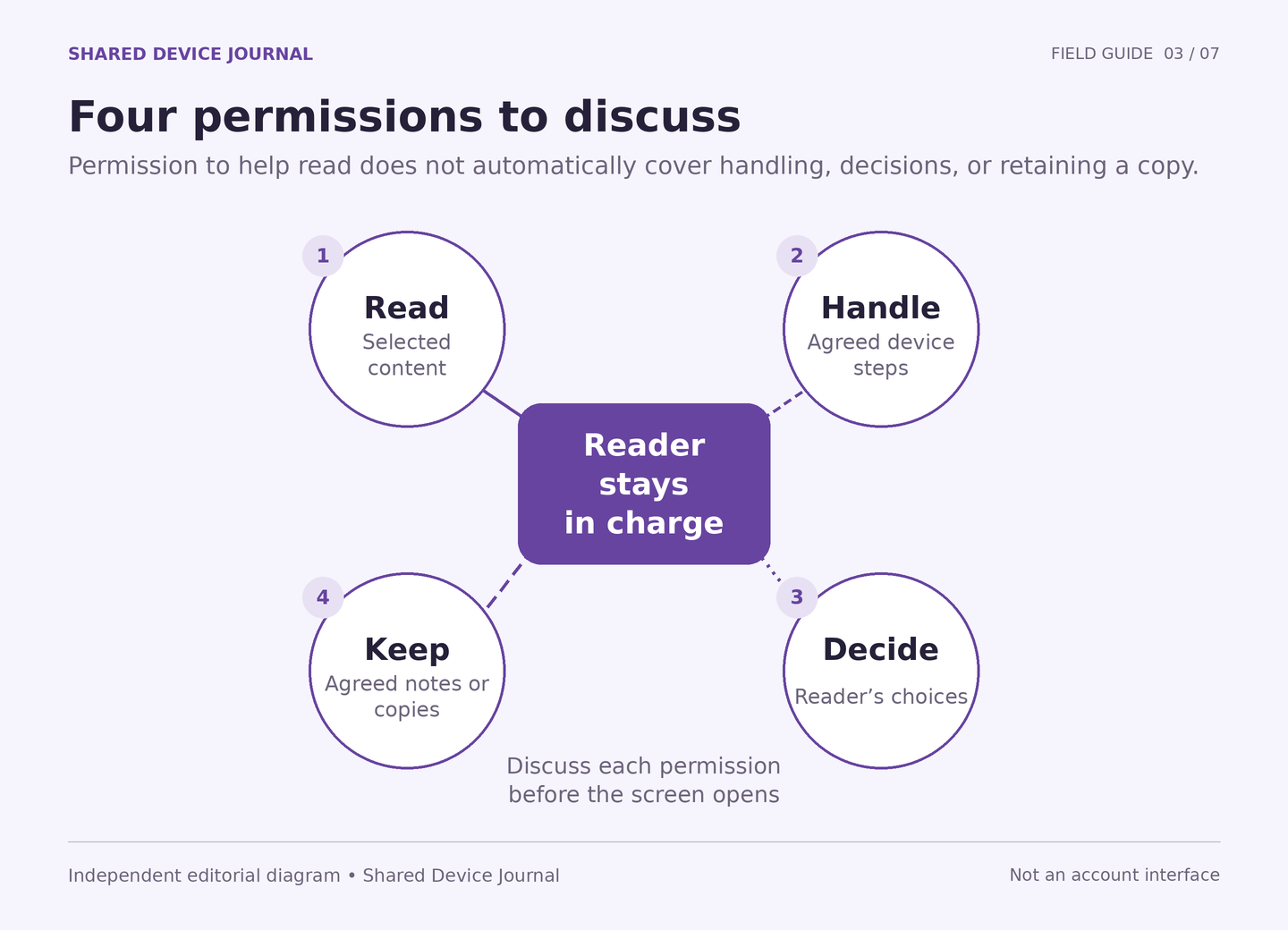
These are three different permissions. Reading means seeing or hearing particular content. Handling means controlling a device, moving a file, or typing. Deciding means choosing an action or agreeing to terms. Permission for one should not be treated as permission for all three. Explain each in plain language rather than relying on a vague promise to “be careful.”
- Reading: Which public page or selected paragraph are we discussing?
- Handling: Who may scroll, enlarge text, or write down the public title?
- Deciding: Which choices remain with the cardholder, and when will we pause?
- Keeping: Will either person leave with a copy or notes, and what exactly will they contain?
Ari can enlarge text while Denise chooses the section. If a private notification appears, they stop and let Denise decide what to do. If a form asks for a decision, Ari reads the wording rather than selecting an answer for her. A helpful phrase is, “I can explain what this sentence appears to say; I cannot tell whether it applies to your account.”
NIST’s minimization concept (external source) supports keeping information use tied to a purpose. Here, that means the helper sees the portion needed for the reading job rather than a whole inbox. These household boundaries are our practical recommendations, not an official authorization scheme.
Plan for accessibility without taking over
Ask what makes the material usable. Bigger text, slower pacing, headphones, a keyboard, or a second reading may help. Test those methods on a public document first through the accessible-reading rehearsal. Do not assume that a person who needs help seeing a page also needs help making the decision it describes.
Keep pauses normal. A reader may want to hear the same sentence twice or ask what a word means before continuing. The helper should not skip conditions because they seem complicated. If a paragraph remains unclear, mark it as a question and preserve the source rather than improvising a simpler rule.
The provider contact page (external source) states that operator relay calls are accepted. That is a concrete official option to investigate where relevant. It does not mean that an informal helper may answer every verification question or that this journal has tested every accessibility feature of the provider’s website or app.
Keep future correspondence under the reader’s control
A one-time helping session can accidentally become an ongoing arrangement if the helper offers their own email or phone for convenience. The linked Republic Bank and Comdata consent (external source) addresses access to contact information and consequences of sharing email access. Review the applicable terms before making contact arrangements.
For Denise and Ari, the practical boundary is simple: Ari’s address is not added during a reading exercise. If Denise cannot receive or retain communications herself, she will ask the provider about her actual options. That question deserves an explicit discussion rather than a quick substitution made to get past a screen.
At the end, Denise reads the final question list herself or has it read back. Ari confirms that no personal copy was intentionally kept. Neither promises that ordinary deletion would erase every possible device trace. For wording help in another language, use the translation boundary guide; for describing a technical problem, use the screen-description method. The session succeeds when the reader leaves better informed and still in charge.
Sources and scope
- External official source: Corpay Prepaid contact page — Provider contact options and acceptance of operator relay calls. Checked 2026-10-04.
- External official source: NIST glossary: Minimization — Limit personal-information handling to what a purpose requires. Checked 2026-10-04.
- External official source: Republic Bank and Comdata E-Sign Consent — Issuer-specific electronic communication, retention and paper-copy provisions. Checked 2026-10-04.