An electronic notice can feel urgent simply because it appears while your shared-computer session is running out. The screen’s time limit is not the document’s meaning. A disciplined reading method gives you a way to understand the notice without letting the setting make the decision for you.
Use three passes: identify the document, read what it says, and identify any next action. The method works with a public example before you involve personal correspondence. It is an original editorial reading aid, not a substitute for the complete notice or advice about your individual legal rights.
Pass one: establish what you are looking at
Find the title, publisher, intended reader, and any date labels. Notice whether the page is a general explanation, an agreement, a change notice, or a message referring you to another document. Do not assume a familiar logo tells you all of those things. A short email may point to a longer notice rather than contain its complete terms.
The provider’s public home page (external source) says Fintwist is now Corpay Prepaid. Both names may therefore matter during research, but the name alone cannot authenticate an unexpected message. The FTC recommends independently verifying unexpected requests through contact information you know is real. Do that before following a suspicious request to enter information or open an attachment.
For practice, use the public Republic Bank and Comdata E-Sign Consent (external source). It concerns electronic communications and names specific organizations. Those are useful scope clues. Finding it publicly does not show that it is the controlling document for every Fintwist or Corpay Prepaid reader.
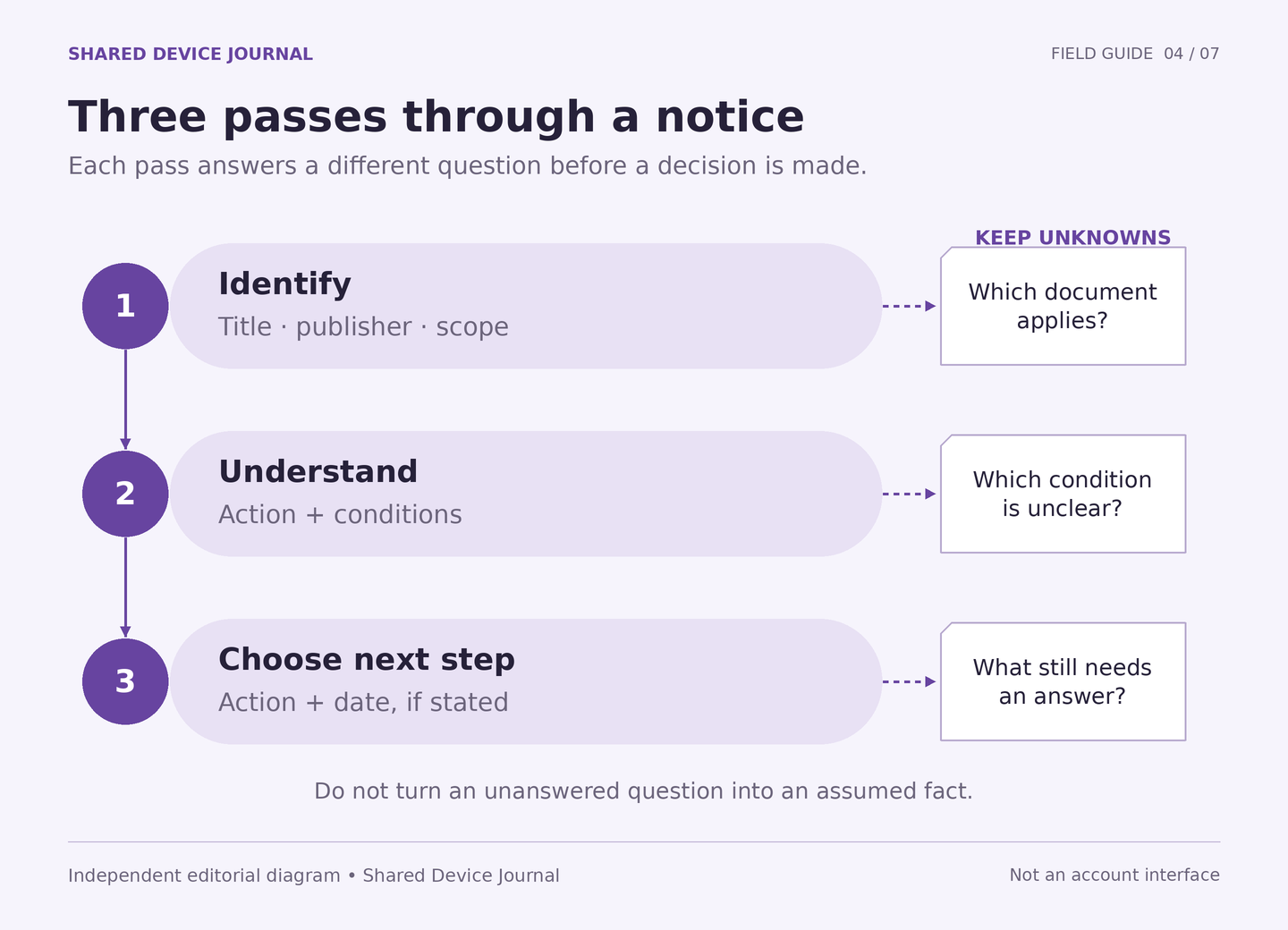
Pass two: read the action and its conditions together
Read one complete section at a time. Identify the action being discussed, the person responsible, and words that qualify the statement. Keep “may,” “must,” “if,” and “after” attached to the sentence they modify. A helper who summarizes only the reassuring half of a paragraph can accidentally remove the part that matters most.
On separate paper, write a question in your own words rather than transcribing whole sections. For example: “What would I need to keep this readable after leaving the library?” This question exposes a practical issue without claiming that you have already met the document’s conditions. You can then locate the relevant paragraph again through the title and section heading.
Fictional reader Tasha is practicing with the public consent document. Her first reaction is that she can open a PDF, so the equipment issue must be settled. A second reading makes her ask whether she can keep a usable copy later. She discovers that today’s viewing and tomorrow’s access are different planning questions. She has not made a consent choice; she has improved her understanding of what to check.
When a term remains unclear, write the uncertainty accurately: “I do not understand what this clause would mean for my program.” Avoid replacing it with an invented rule. A reader can understand the words on a page while still needing an individual explanation of their application.
Pass three: decide what the notice actually asks of you
Look for an explicit requested action and any date or process attached to it. Some documents explain a standing arrangement; others announce a change; others request a response. Do not manufacture a deadline because the page has a date at the top. Use the notice-date guide to separate the different kinds of dates.
Now ask whether the next step belongs in this session. If it is “read the next public section,” you can continue. If it involves personal contact information, an account-specific question, or accepting something you do not understand, move to a suitable private or official route. You do not need to complete every related action on the machine where you first read the words.
In Tasha’s example, her next step is to check her own applicable documents and ask a question about retaining communications. She writes that down. She does not select an option to make the page disappear or ask a helper to agree on her behalf. For a paper-copy question, the copy-request guide helps keep different requests distinct.
Check your summary before leaving
Try a short read-back: “This is the document I read. This is the point I understood. This is the condition I still need to check. This is the next action I have chosen.” If any sentence requires guessing, mark it as unknown. Your summary should preserve uncertainty rather than hide it behind confident language.
Keep the notice itself intact wherever you are entitled to retain it. A personal summary helps you navigate but does not replace the original wording. If a helper participated, review the summary together using the agreed helper boundaries. The helper can confirm that your question matches the paragraph without deciding what you should accept.
A careful reading session may end with one unresolved question. That is an acceptable result. The valuable achievement is that you can identify the source, explain the issue, and choose a next step without mistaking a shared terminal’s countdown for a reason to consent.
Sources and scope
- External official source: Republic Bank and Comdata E-Sign Consent — Issuer-specific electronic communication, retention and paper-copy provisions. Checked 2026-10-04.
- External official source: FTC: Recognize and avoid phishing scams — Verify unexpected requests using independently known contact information. Checked 2026-10-04.
- External official source: Corpay Prepaid home — Naming update and program-specific issuer qualifications. Checked 2026-10-04.