A document that opens on a borrowed computer may be difficult to find or read later. Before relying on that computer for electronic payment information, test the whole retention route: viewing, permitted saving or printing, leaving the venue, and reading again. Use a public practice source or your own harmless sample text rather than a personal notice for the test.
Define what a successful copy means
The Republic Bank and Comdata E-Sign Consent (external source) includes PDF access and a printing or electronic-storage requirement. Treat that as a prompt to examine your actual arrangement, while checking the agreement applicable to your own program.
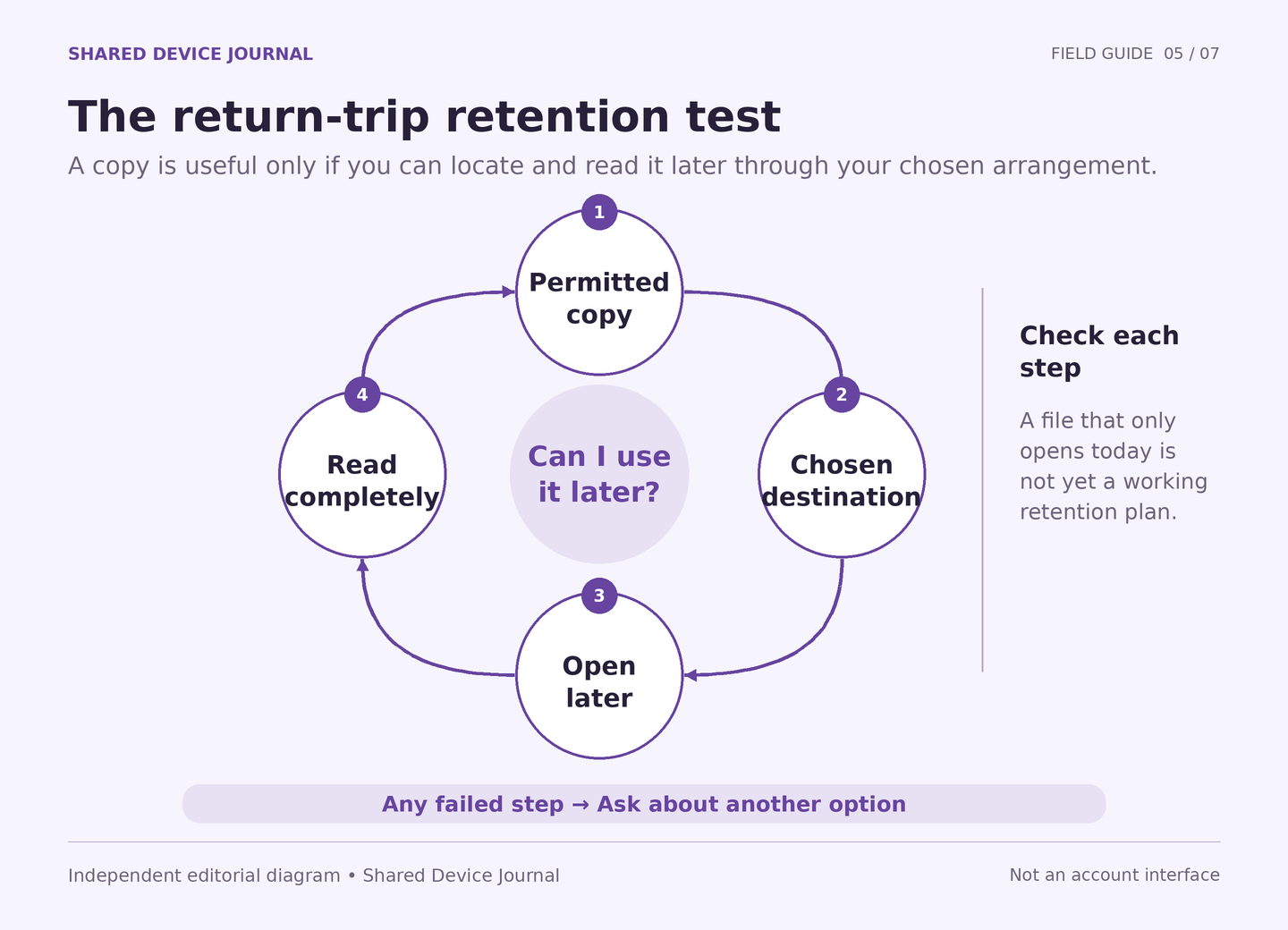
For this exercise, a successful retained copy is one you are entitled to keep, can locate later, can read completely, and can distinguish from a different version. A screenshot of one paragraph may fail the completeness test. A file in a helper’s Downloads folder may fail the later-access test. A perfect-looking print with the final page missing may fail both.
Run the return-trip test
Fictional reader Cal expects to use a community computer once a month. He assumes that anything he views there will be available on his next visit. Instead of testing that assumption with personal correspondence, he asks staff about local storage and permitted printing. He learns only what the venue actually says, without assuming that all public terminals follow the same policy.
Cal then practices with his own one-page sample. He saves it through a permitted route he controls and later opens it from the intended device. He checks the beginning, middle, and end, as well as the filename. The exercise reveals that he had remembered the file’s appearance but not its location. He changes his naming plan before any real notice is involved.
If you practice with provider content, review the linked website-use terms (external source) and the document’s own permissions first. Public availability is not permission to upload or redistribute a copy. A test using your own sample avoids that issue entirely.
Ask what would break the arrangement
Consider a lost storage device, an unreadable print, a helper who is unavailable, or software that stops opening the file. CISA discusses storage loss, encryption, and backups (external source). The practical lesson here is to identify the weak link before relying on it, without attempting to reconfigure someone else’s computer.
If the plan depends on downloading, use the destination check. If it depends on paper, use the printing plan. If the obstacle is reading the content itself, return to the accessibility rehearsal.
Record the result plainly: “I can retain and reopen a complete copy through this method,” or “I still need a workable retention option.” Do not turn a failed test into a claim that you satisfy a requirement. Ask the provider about your options before relying on an arrangement that does not work.
Sources and scope
- External official source: Republic Bank and Comdata E-Sign Consent — Issuer-specific electronic communication, retention and paper-copy provisions. Checked 2026-10-04.
- External official source: CISA: Protect data stored on devices — Storage, loss, encryption and backup considerations. Checked 2026-10-04.
- External official source: Corpay website Terms of Use, January 18, 2025 — Website-content use restrictions; review permitted copying before retaining or redistributing. Checked 2026-10-04.